
The Dark Side of Money: Understanding and Overcoming It’s Power!
We live in a world shaped by both God's good creation and the pervasive influence of the Fall. This duality profoundly affects our capacity for faithful stewardship, often limiting our ability to enact justice and love through our financial lives. Handling money is not merely an exercise in arithmetic; it is fundamentally a spiritual discipline because we are interacting with something that claims a controlling force over our lives.
Jesus and the God of Mammon
Jesus gave money a significant, personified name: Mammon.
Mammon is an Aramaic word typically meaning 'money' or 'wealth.' However, in using this term, Jesus elevated it beyond a simple noun. He did not say, "You cannot serve God and Caesar" or "God and Baal," referencing a known pagan deity. Instead, He introduced a spiritual competitor:
“No servant can serve two masters; for either he will hate the one and love the other, or else he will be loyal to the one and despise the other. You cannot serve God and mammon.” (Matthew 6:24)
By personifying and deifying money, Jesus revealed it as a power—a spiritual force competing for our ultimate allegiance. This power claims divinity and strives to give meaning and direction to our lives. It is not neutral; it actively seeks to direct, move, and control our hearts and minds.
The Apostle Paul spoke of this struggle against unseen forces, particularly in the wealthy city of Ephesus: “For we do not wrestle against flesh and blood, but against the rulers, against the authorities, against the cosmic powers over this present darkness, against the spiritual forces of evil in the heavenly places.” (Ephesians 6:12)

Mammon is one such cosmic power, a spiritual force that drives individuals and nations into conflict, arrogance, and self-destruction, as theologian Paul Tillich noted. Even as we strive to serve God and neighbour, we constantly find ourselves frustrated by "the system" of fallen powers—unjust and unloving systems of business and finance that marginalise or oppose the life of faith.
The deep connection between money and human desire is highlighted by the Hebrew word for money, kesef, which comes from a verb meaning "to desire, to languish after something." This spiritual character and power of money, the lust for it, resides within us from the start.
The key to overcoming this pervasive influence is found in Jesus’ core challenge: You cannot love both God and mammon. The path to freedom is to choose to love God and faithfully obey His Word concerning our finances.
Redeeming Money: Breaking Mammon’s Power
Christ's work on the cross fundamentally broke the power of Mammon. Colossians 2:15 states that Jesus:
“...cancelled the record of debt that stood against us with its legal demands. This he set aside, nailing it to the cross. He disarmed the rulers and authorities and put them to open shame, by triumphing over them in him.” (Colossians 2:14-15)
By allowing Himself to be sold as a slave for money, Jesus used the very mechanism of buying and selling to set us free from its power. We begin the process of redeeming money by consciously transferring all we possess into God’s hands, accepting His ultimate ownership. This act dethrones Mammon, allowing us to manage money rather than being managed by it.
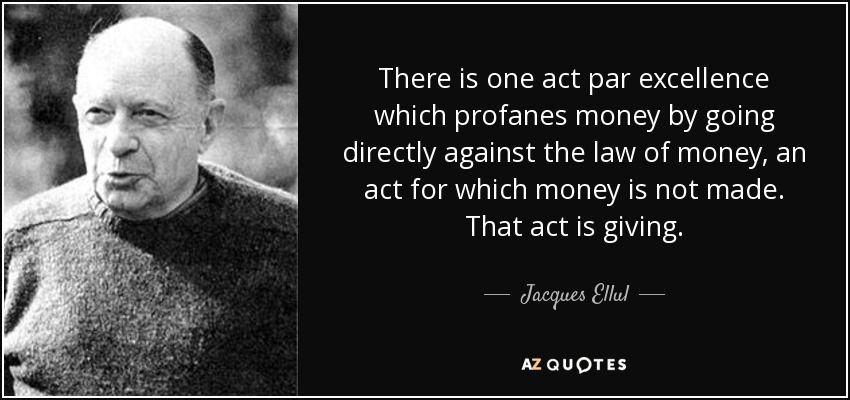
Money is redeemed by stripping away its sacred, false power and redirecting it into God's economy through giving.
1. The Tithe: Defeating the Devourer
Giving the first and best part of our income—the tithe—negates the work of Mammon, the "spoiler" or "devourer."
“Bring the full tithe into the storehouse... And thereby put me to the test... if I will not open the windows of heaven for you and pour down for you a blessing until there is no more need. I will rebuke the devourer for you, so that it will not destroy the fruits of your soil...” (Malachi 3:10-11)
In the world's economy, money is for taking, bargaining, or manipulating. It is not for giving. This is why giving is the most uneconomical—and therefore, the most effective—transaction for defeating the powers of money.
2. Prayer: An Uprising Against Disorder
We can redeem money by engaging in prayer for our businesses, organizations, and government institutions. Theologian Karl Barth once said, “to clasp the hands in prayer is the beginning of an uprising against the disorder of the world.”
“Submit yourselves therefore to God. Resist the devil, and he will flee from you. Draw near to God, and He will draw near to you.” (James 4:7-8)
3. Prioritizing People: Shrewdness for Eternity
Money is redeemed when we consistently choose people over money. Jesus’ parable of the dishonest manager (Luke 16:1-8) praised the manager's shrewdness for using money to reduce his customers' debts and build relationships.
Jesus explained the principle: “And I tell you, make friends for yourselves by means of unrighteous wealth, so that when it fails, they may receive you into the eternal dwellings.” (Luke 16:9)
The shrewdness was not in the wastefulness, but in using money to establish relationships that had spiritual benefits, reducing the burden of debt on others.
The Vision of Redeemed Finance
When God’s redeeming grace operates through people in financial transactions, finance itself can be redeemed to honour God, foster good stewardship, and genuinely show justice and love.
What would your workplace, your business, or your government institution look like if God’s financial principles—based on love, justice, and self-giving—were faithfully carried out? Take a moment to imagine a financial world where Mammon is dethroned and Christ reigns supreme.
Money Theology reveals why economic questions are never merely practical. They're spiritual battlegrounds where ultimate allegiances are tested and revealed.
Money remains a practical tool Christians will use throughout their lives. But it must never become the object of our belief, the source of our security, or the foundation of our hope. That belongs to Christ alone.
.


Comments